
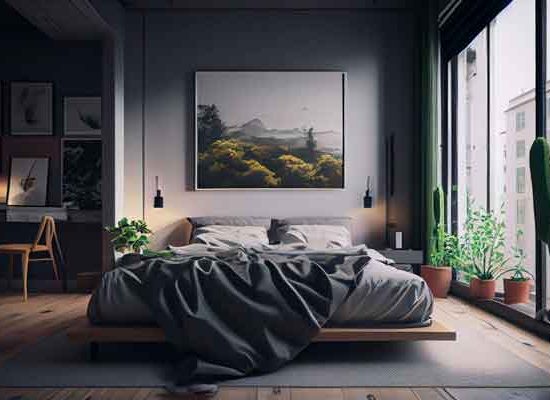
Almost every homeowner dreams of having a spacious and relaxing bedroom.
But in most Bangladeshi homes, bedrooms are usually 10×10 or 12×12 feet — around 150 to 200 square feet.
So, what can you really do when expanding the walls isn’t an option?
The answer lies in smart interior design.
With a few clever adjustments in color, layout, lighting, and materials — your small bedroom can look open, airy, and far more luxurious than its actual size.
Here are 8 tried-and-tested tricks from Dera Interior, one of Bangladesh’s leading interior design consultancies, to make your small bedroom look bigger — instantly.
1. The Power of Paint: How Colors Can Make a Small Room Look Bigger
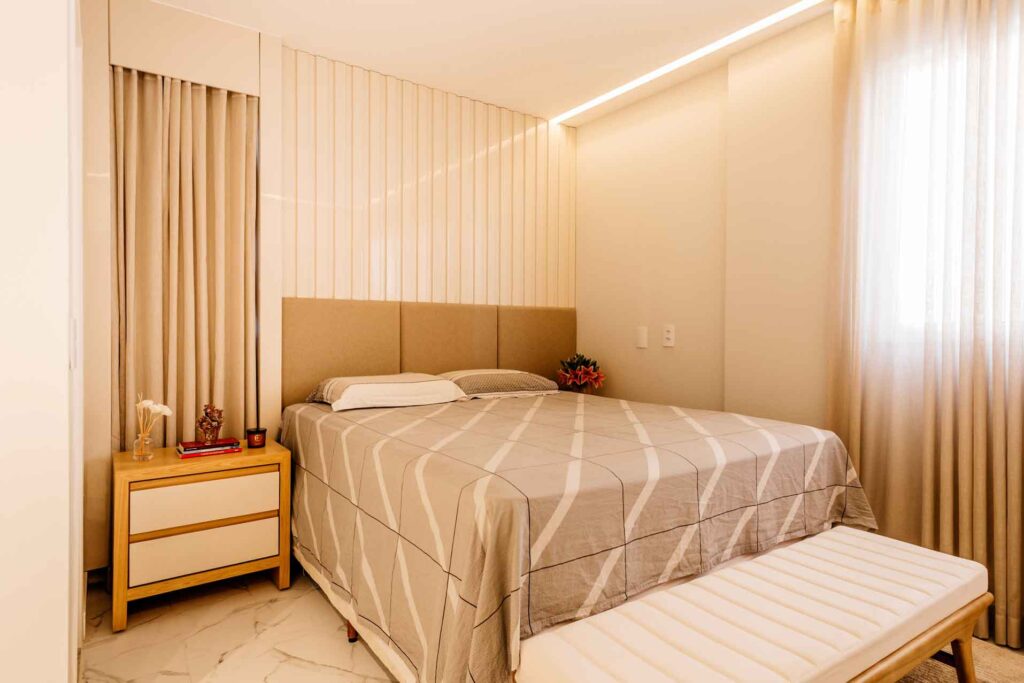
When it comes to making a small room appear larger, paint color plays the most powerful role.
Just a few smart choices can completely transform how spacious, bright, and relaxing your room feels.
There are three golden rules to remember when choosing paint for small rooms:
1️⃣ Keep the colors light.
2️⃣ Avoid matte finishes.
3️⃣ Don’t divide walls with contrasting colors.
Let’s explore each of these one by one.
💡 Rule 1: Always Choose Light Shades
This is simple — dark colors absorb light, making a room feel smaller, heavier, and closed-in.
If your room is already small, dark paint will make it feel even more cramped.
Instead, go for soft, neutral, or pastel shades that reflect light beautifully.
Colors like off-white, beige, light grey, pastel pink, mint green, or powder blue are excellent choices.
They make your space feel brighter, airier, and more open.
In short — avoid deep tones, and stick to neutral or pastel palettes that visually expand your walls.
✨ Rule 2: Never Use Matte Finish in Small Rooms
Paint finishes generally come in two types — matte and glossy.
Matte paint absorbs light, which makes walls look dull and flat.
In a small room, that creates a heavy and shadowed atmosphere.
Glossy or semi-gloss finishes, on the other hand, reflect light —
they help your room feel more vibrant, spacious, and lively.
Now, this doesn’t mean matte finishes are bad.
Matte paint can look stunning in larger rooms where light isn’t an issue —
but in small bedrooms, glossy finishes simply work better.
🧱 Rule 3: Avoid Color Partitions on Walls
Many people make this mistake — painting one wall a different color to “add style.”
But here’s the truth: color partitions visually break the room.
They divide the walls into sections and make your space appear smaller than it actually is.
If your room is already compact, this trick will make it look even tighter.
So, keep your walls uniform in color.
A consistent tone creates harmony, calmness, and a clean visual flow —
making the room feel bigger, brighter, and more peaceful.
💡 Pro Tip: Add Interest Without Breaking the Color Scheme
If you’re worried that a single color might look boring — don’t be!
You can make your room interesting through:
Lighting (warm vs. cool tones for depth and mood)
Textures (fabric, rug, or wall décor)
Accessories (art, mirrors, plants, and furniture contrast)
These elements can add layers of personality while keeping your space visually open and balanced.
🎯 In Summary
Light colors reflect space. Glossy finishes enhance brightness.
And one consistent tone keeps the room united.
Together, these simple paint rules can make your small room look larger, calmer, and beautifully modern.
2. The Power of the Master Wall (Focal Point Wall)
Many people say, “If all the walls look the same, won’t the room feel monotonous?”
That’s exactly where the idea of a Master Wall — also called a Focal Point Wall — comes in.
It’s a design technique that adds interest and personality to your space without breaking visual harmony.
🎨 Stick to a Monochromatic Theme
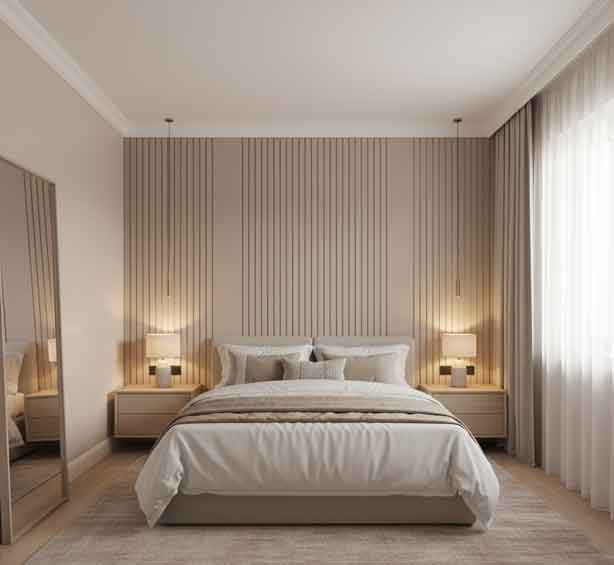
If all your walls are painted in the same color family, the focal wall should not stand out by color, but by texture or detailing.
The golden rule: use the same color family, not a completely different shade.
For example:
If your room is in beige or grey tones, then your master wall should also belong to that same family — perhaps a few shades lighter or darker.
The goal is to add depth, not distraction.
Let’s say your three walls are painted in off-white.
On your focal wall, stay close to that tone — maybe a warmer cream or subtle ivory — but make it special with added elements such as:
Wall paneling
Moulding trims
Framed artwork or photo clusters
Vertical groove lines or patterns
Even with minimal contrast, these additions will turn your wall into the “star wall” of the room — elegant, balanced, and visually spacious.
📏 Use Vertical Patterns to Add Height
When designing the master wall, always try to incorporate vertical designs or patterns.
Why? Because vertical lines create a visual illusion of height.
Our eyes naturally follow upward lines — making the ceiling appear taller and the room larger.
This principle works just like in fashion design:
shorter people are often advised to wear vertical stripes because they create the illusion of height.
Similarly, even if your bedroom isn’t physically large, vertical wall detailing can make it feel taller, grander, and more open — especially if your ceiling height is around 9 to 10 feet
💡 The Secret to a Premium Look
Keep the color family consistent — that’s what maintains harmony.
Then play with texture, grooves, lighting, and patterns to make your master wall come alive.
This subtle contrast in texture (not color) will make your space look more premium, well-balanced, and visually expansive.
🪞In Short:
Stick to monochromatic tones, not contrasting colors.
Add paneling, trims, or artwork instead of bold color changes.
Use vertical patterns to make your room look taller.
Keep everything balanced — elegance lies in subtlety.
Your master wall doesn’t need to shout; it just needs to speak quietly — but beautifully.
3. Smart Furniture Design & Placement for Small Bedrooms
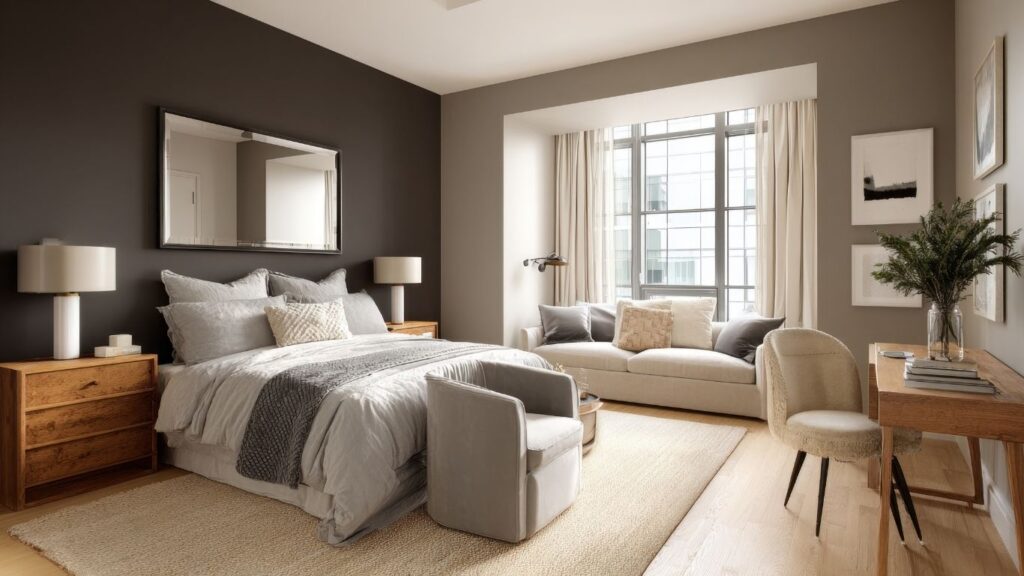
When it comes to making a small bedroom look spacious, furniture plays a key role — not just in style, but also in how you place it.
Whether you choose veneer, laminate, duco, or lacquer finish — the rule is simple:
keep it glossy, keep it light.
✨ 1. Choose Glossy Finishes
Glossy surfaces reflect light beautifully, making the room appear brighter and larger.
So, whenever possible, select furniture pieces with a high-gloss finish.
This single change can dramatically enhance the sense of openness in a small space.
🚫 2. Avoid Heavy Patterns and Bulky Designs
Overly detailed furniture designs or bold textures can make a small room feel cramped and visually heavy.
Since your goal is to make the room look more spacious, try to avoid visual clutter.
Keep the furniture design simple and plain, with minimal contrast.
If you still want some creativity, add light touches like a unique handle design or subtle texture.
For example, a wardrobe with clean surfaces and T-bead detailing on the doors can look stylish yet minimal.
It gives your space that elegant “designer” look — without overpowering the room.
📏 3. Follow the “50–50 Rule”
This is one of the golden rules of small-space design.
Your furniture should never cover more than 50–55% of your floor area,
and at least 45–50% of the floor should remain visible.
This visible floor space is what tricks the eye into believing the room is bigger.
Let’s take an example:
If your room is 10 ft × 10 ft (that’s 100 sq. ft total),
and your bed takes up 6×6 ft = 36 sq. ft,
then a cabinet of 8×2 ft = 16 sq. ft brings you to around 52 sq. ft occupied.
That’s already half the room!
Now, if you add more items — like a study table, side table, or dressing unit —
you’ll lose open floor visibility, making the room feel busy, congested, and airless.
So what’s the solution?
💡 4. Choose Floating or Lightweight Furniture
Opt for floating furniture — pieces that are mounted slightly above the floor.
Examples include:
Wall-mounted TV units
Floating study tables
Floating side tables
These create three amazing benefits:
1️⃣ The visible floor makes your room look larger.
2️⃣ You get extra space for movement and cleaning.
3️⃣ The room feels light, airy, and uncluttered.
If you’re worried about strength or stability, go for light-legged furniture —
like tables, chairs, or beds with slim legs that allow some of the flooring to show through.
They’re strong, stable, and still keep your room feeling open.
🛏️ 5. Utilize Bed Storage Wisely
Modern hydraulic beds are a game-changer for small bedrooms.
They provide hidden storage space beneath the mattress — perfect for keeping extra bedding, clothes, or seasonal items —
without making the room look crowded.
This way, you get maximum functionality without sacrificing elegance.
🌿 In Short:
Use glossy finishes to reflect light.
Keep furniture simple and clutter-free.
Follow the 50–50 rule to maintain open space.
Choose floating or thin-legged furniture to create visual lightness.
Utilize under-bed storage for extra space.
When your furniture is balanced and well-placed, your small bedroom will not just look bigger — it will feel calmer, airier, and truly well designed.
4. Flooring Ideas to Make a Small Room Look Bigger
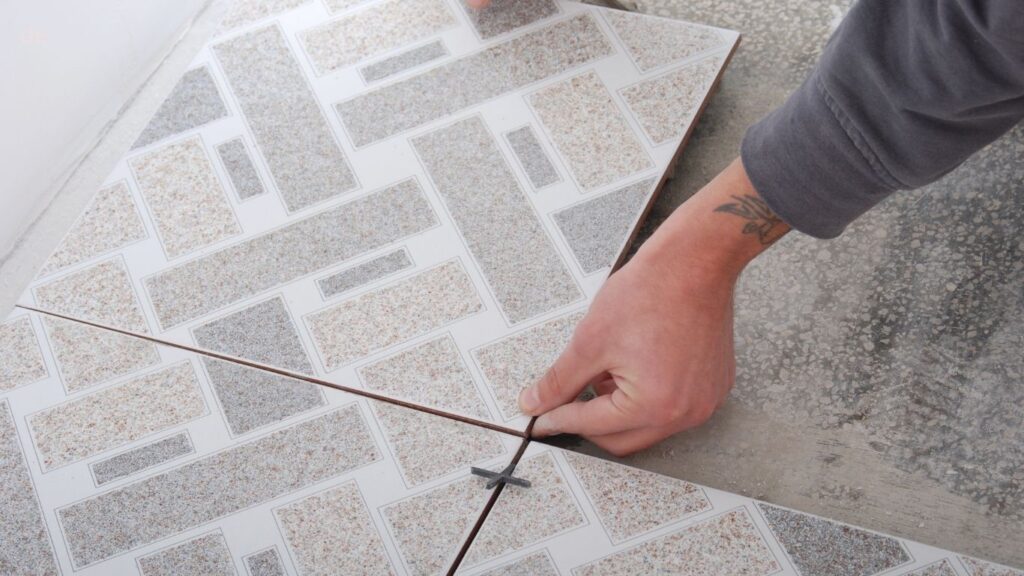
When you’re designing a small room, flooring can completely change how spacious the room feels.
It’s not just about what you use — marble, tiles, or vinyl — but how you use it.
Here’s what you should always remember while choosing flooring for small bedrooms 👇
🔹 1. Choose Large-Format Tiles or Marble
Whether you’re using marble, tiles, or any other material, go for large sizes with minimal cutting.
The larger the tile or marble slab, the fewer the visible joints — and fewer joints mean a continuous, open look that visually expands the space.
Avoid using small tiles like 2×2 ft or 2×4 ft.
Instead, choose 2×5 ft or even 4×8 ft tiles (yes, these large slabs are now available in Bangladesh too!).
Fewer joints = less visual division = a floor that feels longer, wider, and cleaner.
🔹 2. Use “Paper Joint” or Seamless Installation
If you’re installing large tiles, ask your fabricator to lay them in a paper joint or near-jointless style —
that means setting the tiles very closely together without visible grout lines.
However, make sure the tile quality is good —
because poor-quality tiles can bend or crack in the Bangladeshi heat if laid too tightly.
When done right, these ultra-thin joints create a seamless, one-piece floor effect that looks modern, clean, and incredibly spacious.
🎨 3. Keep the Floor Color Light and Harmonious
Your flooring color should always match your room’s overall color theme.
If your room follows a beige palette, choose a floor with soft beige or cream tones.
If it’s grey-themed, go for a subtle light-grey floor.
Light tones reflect more light and maintain visual harmony, making your room feel larger, calmer, and more luxurious.
🔹 4. Choose Minimal Patterns
Try to pick tiles or marble with soft, blurred patterns — not bold, busy designs.
Too much pattern creates visual noise, making the room feel crowded.
If you love patterned tiles, choose subtle lines or delicate shading, ensuring they’re not too dense.
This keeps your space balanced and soothing to the eyes.
💡 Bonus Tip: Try “Joint-less Tiles”
One of the latest trends in flooring is joint-less tiles —
these tiles aren’t completely joint-free, but their designs flow continuously from one tile to another,
so when installed, the floor looks like a single continuous surface.
This effect looks absolutely stunning — and it instantly makes your small room appear more open, elegant, and premium.
So next time you visit a tile store, don’t forget to ask:
“Do you have joint-less tiles?”
Once you see the difference, you’ll never want to go back to regular tiles again. 😉
✨ In Summary:
Pick large-size tiles or marble to reduce visible joints.
Opt for paper-joint or seamless installation for a unified surface.
Keep floor colors light and in sync with your room theme.
Choose minimal, soft patterns for a clean look.
Explore joint-less tiles for a modern, luxurious finish.
A floor that feels uninterrupted and balanced can transform even the smallest bedroom into a sophisticated, open, and elegant retreat.
5. How to Use Mirrors to Make a Small Room Look Bigger
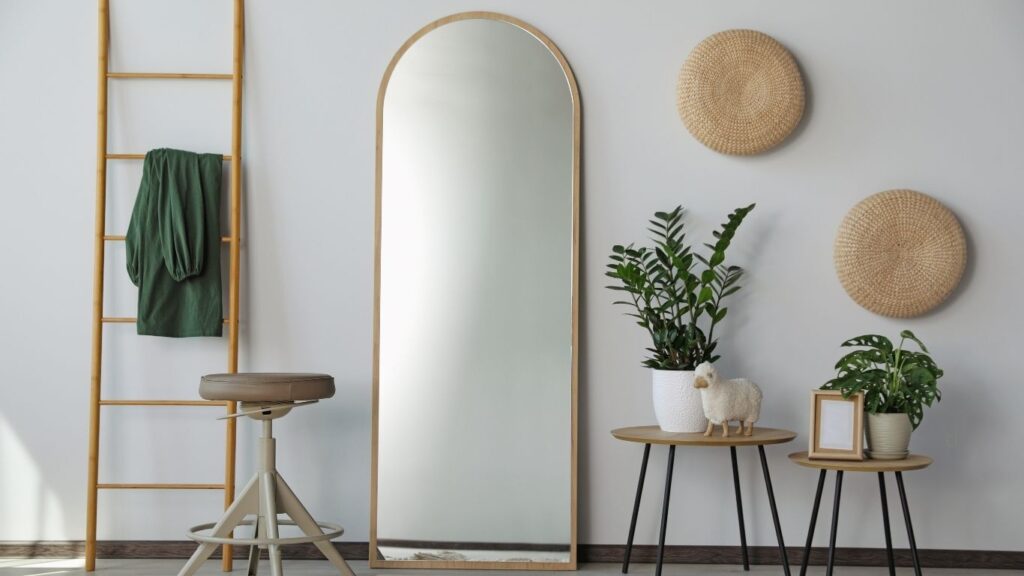
We all use mirrors every day — for grooming, dressing, or just a quick glance before leaving home.
But what most people don’t realize is that a simple mirror can visually double the size of your small bedroom.
Yes, it’s true.
A mirror is not just a reflection tool — it’s a magical interior element that plays with depth, light, and perception to make any compact space look larger and brighter.
🔹 The Magic Behind Mirrors
Have you ever noticed how luxury jewelry stores or high-end showrooms use mirrors almost everywhere?
It’s not just for aesthetics — it’s psychology and design science combined.
Mirrors reflect both light and space, creating an illusion of expansion.
Your eyes and brain perceive the reflected area as an extension of the actual room —
making it feel twice as spacious and infinitely more open.
That’s why, if big shops use mirrors to make already-large spaces look grander,
you can easily use the same trick to make your small bedroom feel airy and elegant.
🔹 Where to Place the Mirror
The placement of your mirror matters more than the mirror itself.
For small bedrooms, the best place to install a mirror is right in front of the main door —
the wall that you see the moment you walk into the room.
Why?
Because when someone enters, the first visual impact comes from that wall.
If that surface holds a large, elegant mirror, the entire reflection of the room appears instantly,
creating the illusion of a wider, deeper, and more luxurious space.
You can either:
Install a mirror wall with decorative framing, or
Integrate a built-in dressing unit with a full mirror front.
Both options enhance the sense of openness and sophistication.
🔹 Full-Height Mirrors — The Modern Trend
Small mirrors or half-height mirrors used to be common,
but they no longer suit today’s modern interiors.
If you truly want your room to look premium and spacious,
go for a full-height mirror — stretching from floor to ceiling.
This design not only doubles the visual height of the room
but also adds a touch of luxury and vertical continuity that feels elegant and calm.
The taller the mirror, the greater the sense of depth and openness.
It’s one of the simplest yet most powerful tricks in small-space design.
💡 Pro Tip:
Before placing a mirror, always check the layout of your furniture —
your bed, wardrobe, windows, and door.
Make sure the mirror reflects open areas or natural light sources, not cluttered corners.
Balanced reflections amplify beauty — not chaos.
✨ In Summary:
Use mirrors as a strategic design tool, not just for daily use.
Position mirrors opposite the main door or open spaces for best visual effect.
Choose full-height mirrors instead of half-size ones — they look modern and make rooms feel grander.
Ensure your mirror reflects light and clean spaces for the best illusion of size.
With the right placement and proportions, a mirror can transform even the smallest room —
from feeling boxed-in to bright, open, and irresistibly stylish.
6. False Ceiling Design Tips — Make a Small Bedroom Look Taller and More Spacious

When it comes to false ceilings, one small mistake can instantly make your room feel smaller, darker, and cluttered. So before we talk about what to do, let’s start with what not to do — because that’s where most people go wrong.
🚫 What Not to Do
1️⃣ Avoid Multi-Level Ceilings
Never install a multi-layered false ceiling in a small room.
Why? Because every layer reduces the ceiling height — making your space feel lower and heavier.
When your room already has a compact size, bringing the ceiling down further will destroy that airy, open feeling.
The goal should be to keep the space feeling light, minimal, and clutter-free.
2️⃣ Avoid Overly Complicated Designs
POP or CNC false ceilings with too many curves, patterns, or intricate detailing may look great in large halls —but in small bedrooms, they make the room feel busy and congested.
Keep your ceiling simple, elegant, and functional.
✅ What You Should Do
Here are 4 smart ceiling design options that make small rooms appear larger and brighter 👇
🔹 Option 1 — No False Ceiling at All
If your ceiling height is already low (8.5–9 ft), skip the false ceiling completely.
Instead, use smart lighting to enhance the look — like profile lights, track lights, or surface-mounted LED panels.
Modern lighting options can give you a premium ambiance without compromising height.
This approach keeps your ceiling height intact while still allowing creative control with lighting.
🔹 Option 2 — Flat “Packed” False Ceiling
If you prefer a cleaner, modern aesthetic — go for a flat, single-layer ceiling that sits just 4 inches below the slab.
This “packed” ceiling hides wiring neatly while giving a uniform look.
Add downlights or cove lights within it for soft, ambient illumination.
This option gives your room a minimalist, spacious look without visual clutter.
🔹 Option 3 — Reverse Cove Ceiling Design
Love soft, indirect lighting? Then this one’s perfect for you.
Here, you create a flat ceiling but leave a recessed border (reverse cove) around the walls.
LED strip lights or hidden profile lights can be installed there, casting a gentle glow upward.
It adds a premium feel and visually pushes the walls outward, making the room feel larger and airier.
🔹 Option 4 — Border Ceiling with Central Height
This is both budget-friendly and elegant.
Make an 18-inch or 2-ft wide border all around the ceiling edges and leave the center portion untouched — at the original ceiling height.
Now add concealed LED lights inside the border.
This trick keeps the middle part of the ceiling full height, which makes the room look taller and more open, while the glowing border adds a stylish frame effect — perfect for modern bedrooms.
✨ Final Thought
The key to false ceiling design in small bedrooms is balance —
avoid clutter, use minimal depth, and enhance light reflection.
Keep your design simple, symmetric, and softly illuminated —
and your room will instantly feel higher, brighter, and far more spacious.
7. Smart Storage Solutions for Small Bedrooms
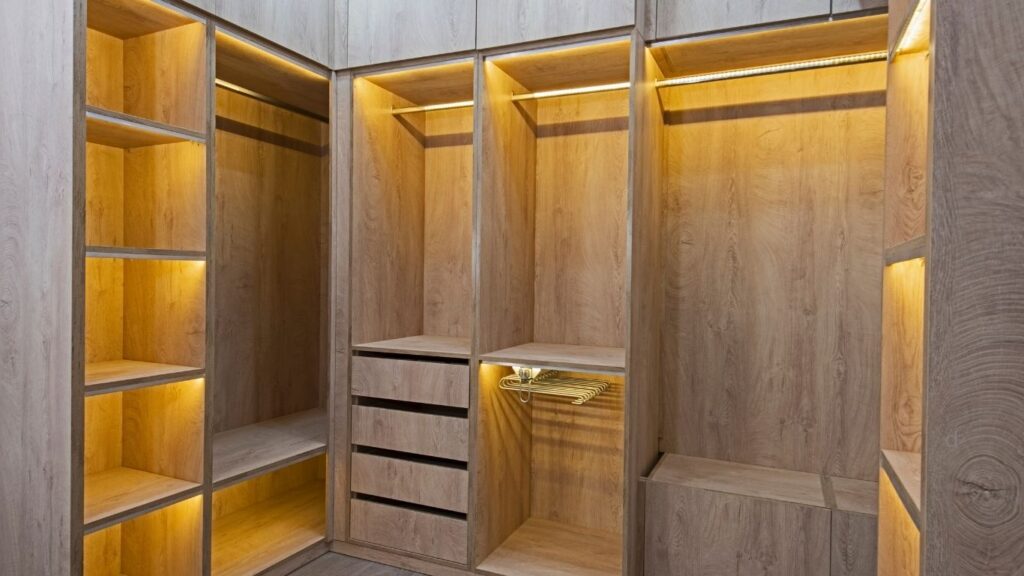
Storage shortage — that’s the biggest struggle in most small bedrooms.
But don’t worry, with a little smart planning and creative furniture layout, you can gain a surprising amount of extra space without crowding your room.
Here are four brilliant and practical storage strategies you can apply according to your room size and needs 👇
🔹 Option 1: Rearrange Your Furniture Layout
If your bedroom is about 10×10 ft and your bed sits right in the center, you probably have only 2 feet of space left on each side.
That makes it impossible to fit a large cabinet or wardrobe.
A better idea is to shift your bed slightly to one side, add a side table next to it,
and use the other side (around 4 ft width) to install a full-height wardrobe.
This way, you’ll still have a comfortable 2 ft walkway while gaining much more storage.
The layout becomes a bit asymmetrical — but it looks modern, practical, and elegant.
🔹 Option 2: Utilize the Wall Above the Bedside Tables
If you prefer to keep your bed in the center, that’s fine too.
You can still make the most of the wall space on both sides of the bed.
Install overhead cabinets or wardrobes above the bedside tables —
they look stylish and add significant storage capacity.
You can design them full-height or keep the bottom part open, depending on how much storage you need.
🔹 Option 3: Add Shallow Shelving Between Wardrobes
If you need even more storage, combine vertical wardrobes with a central shallow shelf between them.
Keep the depth around 1 foot, enough to store essentials without taking up too much space.
This design not only boosts storage but also creates a symmetric, built-in wall unit look —
neat, premium, and clutter-free.
🔹 Option 4: Integrate Storage Around the TV Unit
You can apply the same concept to your TV wall.
Keep the TV in the center, and design storage cabinets around it.
For those who prefer a lighter look around the bed area,
this layout works beautifully on the opposite wall.
✨ Pro Tips from Dera Interior:
Choose handle-less designs with a glossy finish to maintain a clean, spacious look.
Use materials like laminate, veneer, or PVC board — durable, affordable, and stylish.
Avoid dark or heavily patterned textures that visually shrink your room.
And here’s a bonus idea —
Install a hydraulic lift-up bed with hidden storage underneath.
These modern designs are highly functional, stylish, and now widely available in Bangladesh.
They let you store extra bedding, suitcases, or seasonal items without using any extra floor space.
8. Windows & Curtains — The Unsung Heroes of Spacious Design
When we talk about making a small bedroom look bigger, we often focus on wall color, furniture, or lighting —
but there’s one incredibly powerful design duo that people almost always overlook: Windows and Curtains.
Even though they seem like two separate elements, they actually work hand-in-hand to control how open, bright, and spacious your room feels.
Let’s break it down 👇
🪟 1️⃣ Window Design — The Bigger, The Better
If your room is small, here’s one golden rule you should always remember —
👉 The larger the window, the larger the room will feel.
Don’t hesitate when designing your window.
Make it as wide and tall as your structure allows, so that maximum natural light can enter the space.
Natural daylight doesn’t just illuminate —
it opens up your space visually, giving it an airy and expansive feeling.
There’s also a fascinating psychological reason behind this:
when we can see through something transparent — like glass —
our brain automatically perceives the space as larger than it really is.
So, if you’re designing or renovating a bedroom,
maximize both the height and width of your windows to achieve that bright, open, and luxurious look.
🪞 2️⃣ Curtain Design — Small Mistakes That Shrink Your Room
Now that we’ve made the windows large,
let’s make sure we don’t ruin that effect with the wrong curtain setup.
Here are the two biggest mistakes most homeowners make — and how to fix them 👇
🚫 Mistake #1 — Mounting the Curtain Rod Just Above the Window
This is a classic error.
If there’s a 3–4 ft gap between the top of your window and the ceiling,
never place the curtain rod right above the window frame.
That creates a “divided wall effect,”
visually cutting your wall into two separate parts —
and suddenly, your small room looks even smaller.
✅ The Fix:
Always hang your curtains from ceiling height —
just 1 inch below the ceiling line —
and let them fall almost to the floor, stopping about 1 inch above it.
This creates a tall, elegant vertical flow that draws the eyes upward,
making the walls appear higher and the room feel significantly larger.
It’s a simple optical illusion, but it works like magic —
and adds a classy, hotel-style finish to your interiors.
🚫 Mistake #2 — Using a Curtain Rod the Same Width as the Window
This one’s subtle, but it makes a huge difference.
Say your window is 3 feet wide — most people use a 3-foot curtain rod.
That’s wrong. ❌
Why? Because when you open the curtains, part of the fabric still covers the glass,
blocking natural light and making the window appear smaller.
✅ The Fix:
Extend the curtain rod 6 inches beyond each side of the window frame.
So, for a 3-foot window, use a 4-foot curtain rod.
This way, when you open the curtains fully,
they rest outside the window area — allowing 100% sunlight to enter
and keeping the entire window visible.
Result?
Your room feels brighter, wider, and more open —
without changing a single inch of your wall or furniture.
🌤️ Final Thought
Windows and curtains aren’t just decorative —
they’re strategic tools for space design.
By maximizing natural light and creating vertical flow,
you can transform even a compact bedroom into a bright, open, and luxurious retreat.
So next time you design or remodel your home,
give your windows and curtains the attention they truly deserve —
because sometimes, the simplest tweaks create the grandest transformations.
Conclusion: Small Bedroom, Big Feel — The Art of Visual Space
Designing a small bedroom is not about fighting with limited space —
it’s about playing smart with perception.
Every element — from wall color and flooring to lighting, mirrors, and curtains —
can either make your room feel cramped or make it feel spacious, calm, and premium.
The secret lies in balance and illusion.
Use lighter shades to open up your walls.
Create a monochromatic theme that feels consistent and relaxing.
Add vertical patterns to make your ceiling look higher.
Choose large tiles or continuous flooring for a seamless effect.
Introduce mirrors strategically to double the sense of depth.
Keep your false ceiling simple and sleek, not heavy.
And finally — let light and air flow freely through bigger windows and full-length curtains.
Remember, space is not always about square feet — it’s about smart design.
Even the smallest bedroom can feel luxurious and open
when every detail works together in harmony.
So next time you think your room is too small,
look again — maybe it just needs a smarter design touch.
Because at Dera Interior, we believe —
💬 “A beautiful home isn’t about size, it’s about feeling.”