
A Complete, Room-by-Room Guide to Tile Types, Sizes, Finishes and Prices in the Bangladeshi Market.
The tile on your bathroom floor that keeps getting slippery, the one that has already started staining after just two years, or the one that has lost its shine faster than it should have — there is usually one simple reason behind it. The right questions were never asked at the showroom.
Most homeowners choose tiles the way they choose furniture: by how it looks on display. But a tile is not only a design decision. It is a safety decision, a budget decision, and a decision that determines how your entire home looks and feels together for the next ten to fifteen years.
At Dera Interior, we walk almost every client building or renovating a home through this exact conversation. This guide brings together everything you need to know before your next tile-shopping trip in Bangladesh — the types of tiles available, which one belongs in which room, what size works best, and a realistic, cross-checked price range for the local market.
1. Types of Tiles You Will Find in the Bangladeshi Market

At any tile showroom, you will hear a handful of names repeated: ceramic, vitrified or porcelain, GVT, PGVT, and double charge (or double layer). None of this needs to be intimidating. Underneath all these names, there are really only two things that separate one tile from another — how much water it absorbs, and how thick its design layer is.
Ceramic Tiles
Ceramic tiles are the most familiar and the most affordable option on the market. Because they absorb a comparatively higher amount of water, they can develop stains over time in areas that stay consistently wet. This is exactly why ceramic performs best on walls or in low-moisture zones — a wall never holds standing water, so the water-absorption issue never really comes into play there.
Vitrified, Porcelain and Glazed Tiles
Vitrified, porcelain, and glazed tiles are, for practical purposes, three names for the same family of product. They are denser and far harder than ceramic, and they absorb almost no water at all. That is what makes them the stronger choice for floors, wet areas, and high-traffic zones — when water cannot get in, there is much less chance of the tile cracking underneath or losing its colour over time. This added density, and the higher firing temperature required to produce it, is also why these tiles cost more than ceramic.
GVT vs PGVT
GVT and PGVT are two finishes of this same vitrified tile, distinguished by the design-print layer added on top. GVT usually comes in a matte or lightly textured finish, while PGVT is the polished, glossy version. Keep one simple rule in mind: glossy generally means beautiful but slippery, while matte is slightly less shiny but considerably safer underfoot.
Double Charge / Double Layer Tiles
“Double charge” or “double layer” is another term you will come across. Here, the colour and design layer is applied much thicker than on a standard tile. The advantage is durability — if the surface ever picks up a minor scratch, the colour underneath remains the same, so the scratch barely shows. This is why double charge tiles are more hard-wearing and are commonly used in shopping malls and other heavy-traffic commercial spaces.
You will not have trouble finding these terms at a Bangladeshi showroom. Akij Ceramics and CBC Tiles label their products directly as “PGVT.” RAK Ceramics uses “GVT” across its collection. “Double Charge” or “Double Layer” appears in the Akij and Fresh Tiles ranges — Fresh, in fact, claims to be the first company in Bangladesh to introduce a full double-charge tile line. Knowing these terms in advance means you can ask for exactly what you need by brand, rather than relying entirely on a salesperson’s description.
2. The One Rule Behind Every Room: Small Space vs Large Space
Before going room by room, there is one underlying principle worth understanding first, because it applies identically to your living room, bedroom, kitchen, and bathroom.
When a room is small, using a larger tile size reduces the number of grout lines — the joints between tiles. When the eye takes in one continuous tile surface with fewer visual breaks, the brain reads the floor as one large, unbroken plane, and the room ends up feeling bigger than its actual dimensions. This is exactly why a larger tile size is often the right recommendation for a smaller flat or room, rather than the smaller size many people instinctively reach for.
Colour follows the same logic. Light colours — beige, light grey, off-white — reflect more light and make a small room feel more open. Darker colours absorb light and can make a small space feel even more closed in. In a hot climate like ours, light-coloured tiles carry an additional benefit: they visually read as cooler.
A third technique is laying tiles diagonally. This draws the eye from one corner of the room to the opposite corner in a continuous line, which reads as more depth than a straight-laid floor of the same size. It is a particularly effective trick for a small living room or a small bedroom.
Keep these three principles in mind — larger tile size, lighter colour, and diagonal laying where appropriate — and you will be able to work out the right approach for any small room discussed below, even before we spell it out.
3. Room-by-Room Tile Guide
Living Room and Dining Area

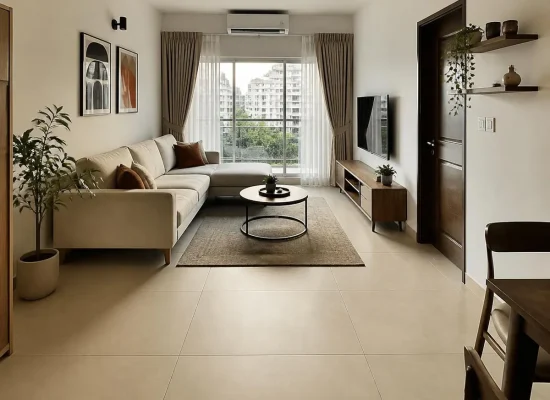
A living room sees foot traffic all day long, but the risk of standing water here is low. This makes it the one space where a glossy PGVT finish is genuinely a good option, alongside vitrified or porcelain tiles in general — in a dry area, a glossy finish does not create a slip hazard, and it makes the room feel brighter and more spacious.
For a medium-to-large living room, a 24″ × 24″ tile works comfortably. If your living room is on the smaller side — a one-bedroom flat or a studio apartment, for example — go even larger, to something like 24″ × 48″. As explained above, fewer grout lines translate directly into a room that reads as bigger than it is.
Bedroom
A bedroom calls for warmth and a sense of comfort, not simply a feeling of scale. Vitrified or PGVT tiles work well here too, and a wood-look tile in particular makes a bedroom feel considerably cosier — the colour and texture of wood create a natural, warm impression that suits a room meant for rest.
The sizing logic stays the same: a larger bedroom can comfortably take a 24″ × 24″ tile, while a smaller bedroom is better served by 24″ × 48″, paired with a lighter colour palette. In a children’s room, or any room where a small child crawls on the floor, avoid a highly glossy finish and choose matte or semi-matte instead — wet hands and feet on a glossy tile meaningfully raise the risk of a fall.
Kitchen

The kitchen is one of the most accident-prone rooms in any home — oil spills, water spills, and the risk of losing your footing while carrying a hot pan can all lead to serious injury.
For this reason, the kitchen floor should always use a matte-finish, anti-skid tile. A glossy or polished tile has no place on a kitchen floor. A size between 16″ × 16″ and 24″ × 24″ works well; if the kitchen itself is small, a larger slab can still be used comfortably. Around the sink, getting the floor slope right so water never pools is at least as important as the tile choice itself.
For the backsplash or wall area, a glossy finish is perfectly fine, since there is no question of anyone standing on it. Choose a smooth tile that wipes clean of oil stains easily — typically in the 8″ × 12″ to 12″ × 24″ range.
Bathroom — The Most Important Decision in the Home

Every year in Bangladesh, a significant number of people — elderly family members and children most of all — are injured after slipping on a bathroom floor. For us at Dera Interior, this is not an abstract statistic. Our founder lost his own grandmother after a fall in the bathroom that ultimately proved fatal. That is exactly why we treat the bathroom floor tile as the single most important tile decision in any home, not a minor detail to settle last.
“This is a decision worth taking seriously — it is not just about tiles, it is about the safety of the people you love.”
Always buy a tile that is clearly and explicitly labelled “anti-skid” for the bathroom floor. In the Bangladeshi market, this is sold as its own distinct category, and you will find it in the collections of nearly every major brand — Akij, RAK, DBL, and Mir among them. These tiles usually have a lightly rough texture on the surface that you can feel by hand.
At the showroom, pour a little water on a tile sample and rub your finger across it to feel how much grip it offers. Ask the salesperson specifically for “anti-skid” tiles by name — asking only for “bathroom tiles” often gets you a regular glossy tile instead.
Most bathrooms in Bangladesh are already on the smaller side, so the small-room sizing rule applies with particular force here. A 12″ × 12″ tile is the most commonly used size for bathroom floors, for two reasons: a smaller tile offers comparatively better grip, and the drainage slope a bathroom floor needs is much easier to get right with smaller tiles.
For bathroom walls, a glossy finish is fine, since there is no question of anyone standing on the wall — typical sizes here are 12″ × 18″ or 12″ × 24″.
On colour: lighter shades show dirt more easily, which naturally encourages more regular cleaning; medium-toned tiles, on the other hand, hide water marks better for everyday use. Either approach is reasonable — the right choice depends on how often your household cleans.
Balcony

Our climate cannot be ignored here — a long monsoon season and constant humidity mean a wrongly chosen balcony tile stays wet and slippery for roughly half the year. Always choose an anti-skid, matte or textured-finish tile for the balcony, and avoid glossy or PGVT tiles here entirely.
For sizing, the same small-space-versus-large-space logic applies as in every other room. There is one exception worth noting: a larger tile makes it harder to maintain the correct drainage slope on a balcony, so going with a smaller size here is not a compromise — it is often the better technical choice. Getting the slope and drainage plan right matters just as much as the tile itself, to make sure water never sits and pools.
4. Making Tiles Work Together Across the Whole House
Having looked at each room separately, one question naturally follows: if every space uses a different tile, will the whole house end up looking disjointed and inconsistent? The answer depends entirely on how you plan it — and there is one design principle worth keeping in mind here.
If your living room, dining area, and kitchen sit within one open-plan space, there is something to settle from the very start. Because the kitchen floor needs an anti-skid, matte finish for safety, carrying a glossy PGVT tile from the living room straight into the kitchen area is not a good idea — a glossy floor in front of a stove is a genuine slip risk.
The cleanest solution is to choose one matte or semi-matte, anti-skid-rated tile for the entire open space from the outset. This way, the living room, dining area, and kitchen can genuinely share the same tile without compromising on safety anywhere. Matte-finish vitrified and GVT tiles look plenty premium in their own right, so there is no need for a glossy finish to make the space feel elegant.
If you do want a glossy finish in the living room specifically, choose an anti-skid tile in the kitchen area that shares the same colour family and a similar size, even if it is not identical. To keep the meeting point between the two tiles from looking accidental, switch tiles exactly along the line where the kitchen counter or platform begins — that way it reads as intentional zoning rather than a sudden change.
In general, the less visible the division between tiles, the larger the whole open space will feel — so wherever possible, keep the floor as consistent as you safely can.
In the bedroom, using a different tile — a wood-look tile, for instance — is perfectly fine, since a bedroom is a private space with its own character. The one thing to watch for is colour — make sure the tile’s colour family does not clash with the rest of the house. If the living room uses a light grey-beige tone and the bedroom suddenly switches to a deep red or bright blue, moving between the two rooms will feel visually jarring, and the home will not read as one cohesively planned space. Keep the same colour family, or a closely related tone, even when the bedroom design differs.
Bathrooms and kitchens will always need distinctly practical tiles of their own, and that is nothing to worry about — these spaces are usually separated by a door and are not in the direct line of sight from the living room. Even so, keeping to an overall neutral or light colour family here means the transition will not look out of place even with the door open.
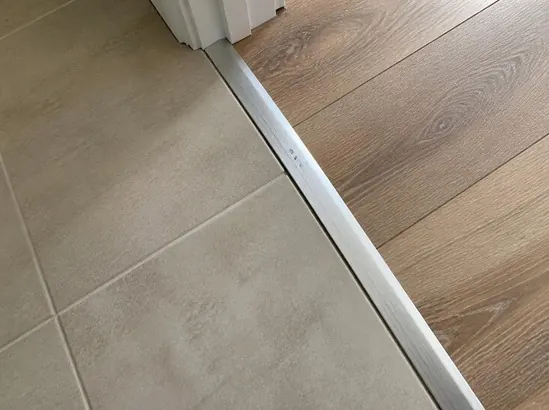
One practical tip: wherever two different tiles meet — say, under the door between the living room and a bedroom — install a thin metal or marble strip, known as a transition strip. It makes the joint between two different tiles look clean and deliberate, rather than like an abrupt, accidental change.
Finally, watch out for one common mistake — filling the whole house with four or five different tile patterns and colours. This makes a home feel cluttered and unplanned rather than well designed. A good rule of thumb is to limit the entire house to two or three tile “families” at most: one primary floor tile for the living room, dining area, and corridors; one for the bedrooms; and a practical anti-skid line for wet areas. Staying within this limit is what makes a home look coherent and professionally designed as a whole.
5. Bangladesh Tile Price Guide (Per Square Foot)
Price is where most decisions get made, so it deserves a clear-eyed look. The figures below are cross-checked across several Bangladeshi market sources and represent an approximate range per square foot — not a fixed, final price.
Bangladesh Tile Price Guide (Per Square Foot)
| Tile Type | Common Size | Approx. Price (per sqft) |
|---|---|---|
| Standard ceramic floor tile | 12″ × 12″ | ৳ 50 – 100 |
| Standard ceramic floor tile | 16″ × 16″ | ৳ 70 – 120 |
| Standard vitrified floor tile | 24″ × 24″ | ৳ 90 – 130 |
| Double charge / double layer tile | 24″ × 24″ | ৳ 120 – 150 |
| Anti-skid tile (budget, ceramic-based) | 12″ × 12″ | ৳ 45 – 80 |
| Vitrified / glazed porcelain (mid-range) | Various | ৳ 120 – 250 |
Note: Prices vary by brand, grade (A/B/C), and dealer — always confirm the current price at the showroom before purchase.
A quick word on why prices move the way they do. A standard ceramic tile is fired at a lower temperature using a less dense material, which keeps manufacturing costs — and the price — down. As tile size increases, price rises too, since a larger tile uses more raw material and is more prone to breakage in transport, which adds to handling costs. Double charge tiles cost more than a standard vitrified tile of the same size because the colour layer is applied much thicker during manufacturing — but in exchange, you get a tile that keeps its design intact even if it picks up a scratch, which makes it a long-term investment rather than simply an added expense.
On anti-skid tiles specifically, one clarification is worth making. Anti-skid is not a separate category of tile material — it is a surface texture treatment that can be applied to either a ceramic or a vitrified base. The most budget-friendly anti-skid tiles on the market are typically built on a ceramic base: the glazed texture on top prevents slipping, but because the base material is ceramic, there is some long-term possibility of moisture creeping in near the joints or any cut edges. If budget is not the primary constraint and you want the strongest long-term solution for a bathroom floor, look specifically for an anti-skid tile built on a vitrified or porcelain base — here, water absorption is close to zero and the slip risk is low at the same time, giving you both advantages together. This version costs a little more than a standard anti-skid tile, but for a bathroom floor, that extra cost is a reasonable trade-off.
For mid-range vitrified or glazed porcelain collections, expect to pay somewhere between ৳120 and ৳250 per square foot. Brands such as Akij, RAK, DBL, Mir, Great Wall, Fresh, and CBC each price their ranges a little differently, and pricing also varies within a single brand depending on grade — typically labelled A, B, or C.
One honest note: these figures have been cross-checked across multiple sources, but tile prices shift month to month and vary by brand and dealer. Treat this as a planning guide, not a final quote — always confirm the current price directly at the showroom before you commit to a purchase.
One more practical piece of advice: never make a final colour decision under showroom lighting alone. Take a sample tile home and look at it in daylight and again under your evening lights — the exact shade you see under a showroom’s special lighting often looks noticeably different once it is in your own home.
6. Why This Decision Matters
A tile is not just a construction material. It is the safety of your everyday movement through your home, the safety of your parents walking into the bathroom, the surface your child crawls on. Choose correctly once, and it will keep you at ease for years. Choose incorrectly, and it means repeated repairs, repeated expense, and, at times, a genuine risk of injury.
So the next time you go shopping for tiles, do not ask only whether it looks beautiful. Ask whether it is safe for the specific space it is going into, whether it will hold up over time, whether it will look right alongside the rest of your home, and whether it is genuinely the right choice for your family.
Frequently Asked Questions
Is an anti-skid tile the same thing as a ceramic tile?
No. Anti-skid describes a surface texture, not a base material. Anti-skid tiles are made on both ceramic and vitrified/porcelain bases; the base material determines long-term water resistance, while the texture on top determines slip resistance.
What is the best tile size for a small bathroom?
12″ × 12″ anti-skid tile is the standard choice for most Bangladeshi bathrooms, mainly because it offers better grip and makes it easier to maintain the necessary drainage slope.
What is the real difference between GVT and PGVT?
Both are vitrified tiles with a printed design layer. GVT is typically matte or lightly textured and safer for wet or high-traffic areas; PGVT is polished and glossy, better suited to dry areas like a living room or bedroom.
Are double charge tiles worth the extra cost?
For heavy-traffic areas, yes — the thicker colour layer means scratches do not expose a different-coloured base underneath, which keeps the floor looking new for longer.
Need Help Choosing the Right Tiles for Your Home?
This is exactly the kind of decision Dera Interior helps clients work through every day — from the first floor plan to the final tile order. If you are building or renovating a home, office, showroom, or restaurant anywhere in Bangladesh, our team can guide you through material selection, 3D design, and full execution.
Dera Interior (ডেরা ইন্টেরিয়র)
3rd Floor, House 17, Road 13, Nikunja-2, Khilkhet, Dhaka
Phone: 01303907056
What’s app: https://wa.me/8801303907056
Website: derainterior.com